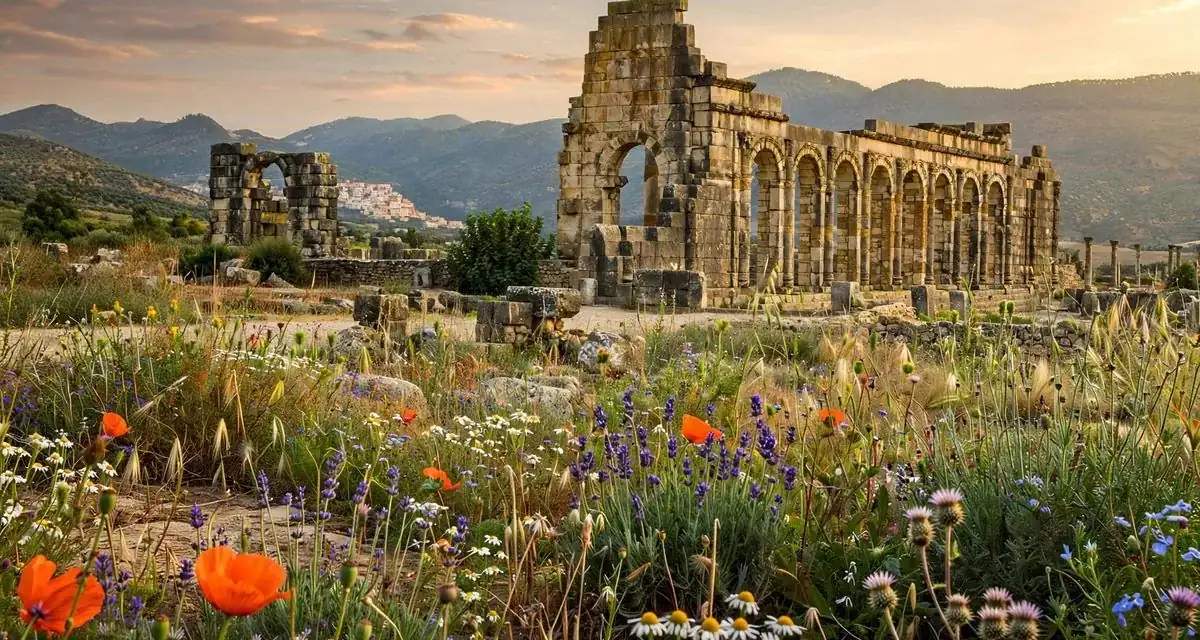
In short. Volubilis is the best Roman site in Morocco, a ruined city on a hill near Meknes with fine mosaics, tall columns and wide views over the plains. It was a Roman city from the 1st century, and it was left empty in the 11th century. This guide covers its history, what to see, how to get there from Fes or Meknes, and how to plan a visit that fits your trip.
The History of Volubilis
Volubilis started as a Berber town, then became a Roman city in the 1st century AD. It grew rich on olive oil, grain and trade, and at its peak about 20,000 people lived here. The city had a forum, a basilica, baths, temples and large houses with mosaic floors. It was the southern edge of the Roman world in this part of Africa.
Roman rule ended in the 3rd century, but the city lived on for centuries. It was left empty in the 11th century, and its stones were later taken to build Meknes. The site was buried under earth until digs in the 20th century brought it back to light. Today it is a UNESCO site, and it is one of the few places in Morocco where you can walk a Roman street and see the city plan in full.
What to See: Mosaics and Monuments
The mosaics are the best part of Volubilis. The large houses have floors with scenes from Roman myths: Orpheus with animals, Hercules and his labours, and the four seasons. The mosaics are in place, open to the sky, and easy to see from the paths. The House of Orpheus and the House of the Knight are two of the best, and they are near the main street.
The forum, the basilica and the Capitoline Temple stand at the heart of the city. The basilica has tall columns that show the scale of the place. The triumphal arch, built in 217 AD, marks the main road and is the most photographed spot. Walk the main street, the Decumanus Maximus, from the arch to the far gate. It takes about 20 minutes, and it gives you the full feel of the city.
Planning Your Visit
Volubilis is open every day, usually from 9 am to 6 pm, with shorter hours in winter. The entry fee is a few dirhams, and a local guide can be hired at the gate for a small fee. A guide is worth it, as the site has few signs and the history is hard to read from the stones alone. Plan two to three hours for the visit, including the walk and the museum.
Bring water, a hat and sunscreen, as there is little shade on the site. The ground is uneven, with stones and grass, so wear shoes with grip. The best light for photos is in the morning or the late afternoon. Midday is hot in summer, so start early. There is a small cafe and a shop at the gate, and toilets near the entrance.
How to Get There from Fes and Meknes
Volubilis is about 30 km north of Meknes and about 60 km west of Fes. From Meknes, the drive takes about 45 minutes. From Fes, it takes about 90 minutes. Most visitors go by private car or by tour, as there is no direct bus to the site. A taxi from Meknes can take you there and wait, but agree the price and the waiting time before you leave.
The best plan is to combine Volubilis with Meknes and Moulay Idriss. Start in Meknes, drive to Volubilis in the morning, stop at Moulay Idriss for lunch, and return to Meknes or Fes in the afternoon. A full-day trip from Fes covers all three places in about eight hours. If you have a car, the roads are good and the signs are clear.
Moulay Idriss: The Holy Town Nearby
Moulay Idriss is a small hill town about 5 km from Volubilis. It is the burial place of Idriss I, the founder of the first Moroccan dynasty, and it is a holy town for Moroccans. The town is built on two hills, with white houses, narrow lanes and views over the plains. Non-Muslims cannot enter the mosque or the tomb, but they can walk the streets and enjoy the views.
Stop in Moulay Idriss for lunch after Volubilis. The small restaurants serve tagine and grilled meats, and the cafes have views over the valley. The town is quiet and steep, so wear good shoes. A short walk of 30 minutes covers the main lanes. The cafes on the square serve mint tea with views over the valley, and the small shops sell pottery and olive oil from the area. If you have time, climb to the viewpoint for the best photo of the town and the plains below.
Volubilis with Children and Families
Volubilis works well for families with children over six. The site is open, the paths are wide, and children like the mosaics, the columns and the open space. Give them a simple task, such as finding the Orpheus mosaic or counting the columns at the basilica. The visit takes about two hours at a family pace, which is enough for most children. After the visit, lunch in Moulay Idriss is a good rest, and the drive back to Meknes takes about 45 minutes.
Bring water, snacks and sun hats, as there is little shade. The site is not good for pushchairs, as the ground is uneven and the paths are stone. Carry small children instead. A guide can tell stories that keep children interested, so ask for a guide who is good with families. After the visit, lunch in Moulay Idriss is a good rest before the drive back.
Volubilis and the Roman World in Morocco
Volubilis is the main Roman site in Morocco, but it is not the only one. The Romans also built at Lixus near Larache, at Sala Colonia near Rabat, and at Cotta near Tangier. Volubilis is the best kept and the easiest to visit, with the finest mosaics. It shows how far Roman trade reached, and how a city on the edge of the empire lived and worked.
If you like history, add Volubilis to a Fes or Meknes trip. It takes half a day, and it gives you a clear break from the medinas. The site is quiet, open and easy to walk, and the views over the plains are wide. It is a good stop for travellers who want to see a different side of Morocco, one that is older than the medinas and the mosques. Bring a guidebook or hire a guide at the gate, as the site has few signs, and a guide can point out the mosaics and the house plans that are easy to miss on your own.